
Pick My Brewer is reader-supported. When you buy through links on this page, we may earn a commission at no extra cost to you.
If you are shopping for a home espresso machine, two names come up again and again: Breville and De’Longhi. Breville is an Australian company founded in Sydney in 1932, and it has built its reputation on polished, hands-on machines that bring cafe-style control to the kitchen counter. De’Longhi is an Italian company founded in Treviso in 1902, and it offers one of the widest espresso lineups anywhere, from slim manual machines to fully automatic bean-to-cup models.
Both make excellent machines. The right choice depends less on the logo and more on how involved you want to be in making each cup, how much counter space you have, and whether you want milk drinks at the touch of a button.
The quick answer
Choose Breville if you want to learn the craft of espresso and value fine control over grind size and extraction, with a large ecosystem of accessories and guides to grow into.
Choose De’Longhi if you want a compact machine, a wider spread of price points, a longer standard warranty, or a fully automatic machine that grinds, brews, and froths milk for you.
How the two brands differ
Philosophy
Breville designs most of its espresso machines around the semi-automatic workflow: you grind, dose, tamp, pull the shot, and steam the milk yourself, with smart features to keep the results consistent. De’Longhi covers that workflow too, but it puts just as much effort into convenience, with a deep range of super-automatic machines that handle every step.
Range and size
De’Longhi spans more categories and sizes, including some of the narrowest espresso machines sold. Its Dedica line is under 6 inches wide. Breville’s lineup is tighter and more focused, with fewer models at each level but a very consistent design language across them.
Automation
This is the biggest split. De’Longhi sells a broad line of fully automatic machines, such as the Magnifica, Dinamica, and Eletta families. Breville’s most automated machines are its Oracle models, which automate grinding, dosing, tamping, and milk texturing but still use a portafilter and cost considerably more.
Warranty
Breville’s espresso machines typically carry a 1-year limited warranty. De’Longhi currently offers 2 years on its espresso machines in the US, plus an extra year on many models when you register the product.
Shared ground
Both companies also build Nespresso machines under license, which is why you will see the same Nespresso model sold under both names, such as the Vertuo Pop+ Deluxe.
Head to head: Barista Express vs La Specialista Arte
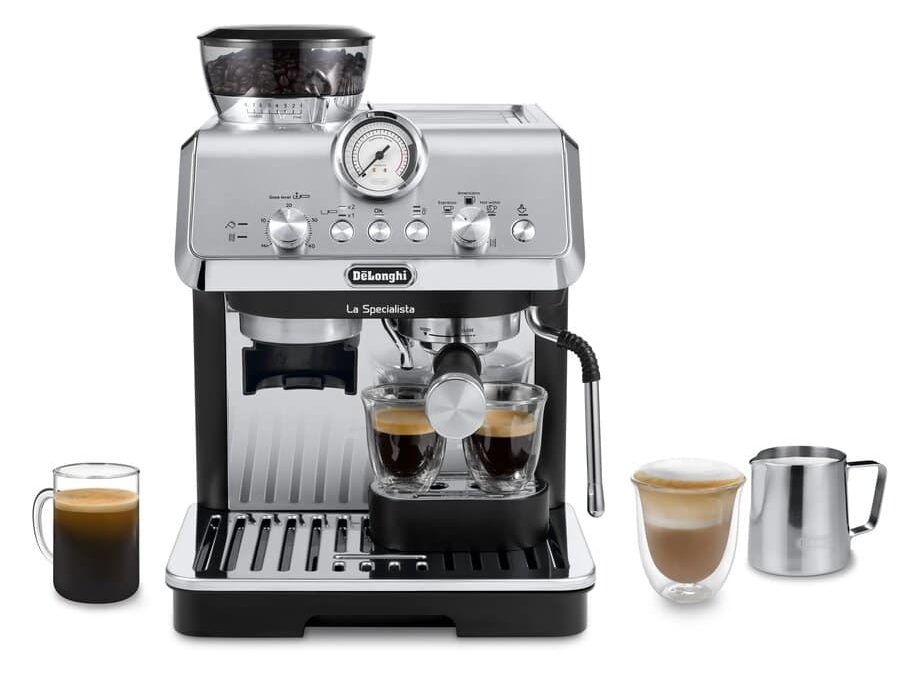
This is the matchup most shoppers are really asking about. Both are all-in-one machines with a built-in grinder, aimed at people who want fresh, hand-crafted espresso without buying a separate grinder.
| Breville Barista Express | De’Longhi La Specialista Arte | |
|---|---|---|
| Built-in grinder | Conical burr | Conical burr, 8 settings |
| Temperature control | PID, held steady automatically | Three selectable infusion temperatures |
| Water tank | 67 oz | 57 oz |
| Milk | Manual steam wand | My LatteArt manual steam wand |
| Included extras | Tamper, milk jug, filter baskets | Full barista kit with dosing funnel and tamping mat |
| Warranty | 1 year limited | 2 years, plus 1 with registration |
| Price tier | Splurge | Splurge |
Pick the Barista Express if you want more room to dial in your grind and a machine with a long track record. Its 54 mm portafilter is widely supported, so upgrades like precision baskets and bottomless portafilters are easy to find. Expect a real learning curve, and note that it cannot brew and steam at the same time.
Pick La Specialista Arte if you want a tidier, more guided experience. The dosing funnel keeps grounds off the counter, the three temperature settings make it easy to adapt to light or dark roasts, and the longer warranty is a genuine advantage. The trade-off is fewer grind settings for fine-tuning and less clearance for tall cups.
Compact and entry level: Dedica vs Bambino
If you already own a grinder, or plan to buy one, a compact machine without a built-in grinder saves money and space. De’Longhi’s Dedica Deluxe is just 5.9 inches wide and heats quickly thanks to its Thermoblock system. It also accepts E.S.E. pods, which is handy on busy mornings. Breville’s closest rival is the Bambino family, known for its very fast heat-up and the same 54 mm portafilter as the Barista Express. The Bambino Plus adds an automatic steam wand that textures milk for you.
For the smallest footprint and pod flexibility, the Dedica wins. For a bit more control and an easier upgrade path, the Bambino line is worth a look.
Fully automatic: where De’Longhi stands alone
If you want a latte without learning to tamp or steam, De’Longhi has the clear edge. The Magnifica Evo with LatteCrema grinds, doses, and brews at the touch of a button, then froths milk automatically in a removable carafe. Seven one-touch drinks include espresso, cappuccino, latte macchiato, and coffee over ice. Breville has no direct equivalent at this level, since its Oracle machines sit in a much higher price bracket.
Which should you buy?
- You want to learn espresso as a hobby: Breville Barista Express.
- You want a grinder built in but less mess and a longer warranty: De’Longhi La Specialista Arte.
- You are short on counter space: De’Longhi Dedica Deluxe.
- You want one-touch milk drinks: De’Longhi Magnifica Evo.
Still deciding? Browse every machine side by side in our espresso machine guide, or add a few to the comparison tool to line up their specs.
Check Price on Amazon: Breville Barista Express
Check Price on Amazon: De’Longhi La Specialista Arte
Check Price on Amazon: De’Longhi Dedica Deluxe
Check Price on Amazon: De’Longhi Magnifica Evo